Welcome to
Living Smaller & Loving It!
All the Rest!
Brought to you by Downsizing Simplified.
Stories, Snippets, & Shares
HELLO! We've revamped our
page into something new and fresh. The new page, "All the Rest," is a little more wide-reaching and includes a variety of downsizing topics, our reformatted FAQs, website updates, and an "Ask Cindy" column.
We will share real-life downsizing stories, informative snippets and links to numerous external resources.
"All the Rest" promises an informative and fun-to-follow experience, so be sure and subscribe below so you don't miss an update.
The excitement is building as our downsizing how-to book publish date is just around the corner!
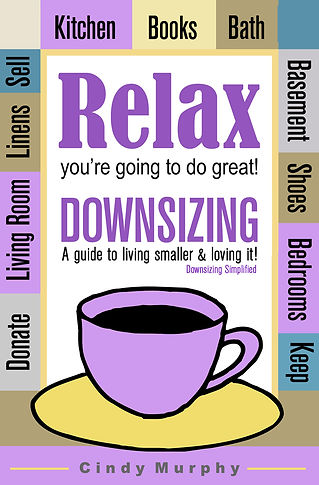
October 2026 release.
If you'd like to reserve a copy, connect with us through the Contact page of the website.
Additional book details to follow!
ASK CINDY
This is a column dedicated to shedding light on some of the perplexities most commonly associated with downsizing.
How do I know if I need help? There are days when I believe I'm on top of things and days when I can't see the forest for the trees. I'm just afraid if I hire someone to help me I'll have to spend too much time overseeing what they're doing. Help!
Dear Help,
It's normal when faced with such a big task as downsizing to feel like if you just had some help!
It becomes very difficult to manage progress especially if you're trying to accomplish tasks in a short or reduced amount of time. You are the best gauge of your progress, and you know if you're on schedule or lagging behind.
Having a plan of action in place is the best thing you can do. Your plan will be specific to your needs and spell out everything that needs to be completed--those big tasks can become a real burden. If you don't have a plan, it's probably time to put one together now. From that plan, you'll be able to see the areas you may need extra help with.
A professional downsizing specialist will be on your team and not someone who needs constant supervision. Have the specifics in place so they will know exactly what you need from them. A seasoned downsizing pro will be able to step in and get things done for you. Tasks managed and completed, and money well spent!
Best of luck! Keep in touch with your progress. Our shared experiences help others going through the same thing.
For more information see Episode #28 of "Living Smaller & Loving It!" blog:
Hiring a Downsizing Specialist
It's NEVER too early to start the downsizing process.
Tell us if you're:

We'd love
to hear
from you!
-
Do you have an "Ask Cindy" downsizing question?
-
Are you considering downsizing (even if you're not moving) and need to get rid of stuff?
-
Are you feeling discouraged just thinking about everything you need to do and don't know where to begin?
-
Are you trying to commit to downsizing but are dragging your feet because the process seems too big?
-
Are you currently up to your elbows in the process steps and feeling overwhelmed? Are you ready for help to step in?
-
Are you having difficulty staying on track? Are you easily distracted?
-
Have you finished your downsizing journey and are now"Living Smaller & Loving It!"?

It may be time to downsize if...
-
You've come to the conclusion that the excess stuff in your life is annoying.
-
Your around-the-house "to-do" list keeps growing with not many tasks being checked-off.
-
You secretly envy those who have free time on their hands.
-
Walking into your garage and basement makes you anxious.
-
You still dream of a first-floor laundry even though the dream evaporated years ago.
-
You're holding yearly garage sales hoping to eliminate some of your excess.
-
Your adult children have started dropping hints about the advantages of hiring professional handymen.
-
You dream of a walk-in shower.
-
You've closed off all the unused rooms in the house, and you actually like living in a smaller space.
-
You are tired of climbing stairs.
-
You can no longer park your car in the garage because of all the clutter.
-
You absolutely dread fall and spring yard cleanups.
-
Your kids are suggesting it may be time to consider getting rid of some of your stuff.
for our upcoming survey asking: "Where do you
want to live and why as
you age?"
Placeholder
If you'd like to be notified about the survey, please
complete the form below. Thanks!
We deliver meaningful downsizing content. Attendees receive valuable information that enables them to begin their downsizing journey!
As a possible attendee, what's your preference:
In-person or virtual (Zoom)? Let us know.
Senior Living Communities...our in-person seminars are an affordable way for us to reach potential new residents for you! Call Cindy for details @ 816.358.6338 or email at:
Book your seminar today!
Seminars
"Never allow clutter to steal anything from you including the fabulous life you deserve." C.Murphy

Delete the excess in your life!
Looking for a senior living community?
Our newest webpage can help!

A valuable, easy-to-use resource,
our "Senior Living in Kansas City" webpage
is organized geographically

and features 200 +/- senior communities and apartments.
Vintage Map Design, Downsizing Simplified © 2026
A very important component of the Senior Living in Kansas City page, is our exclusive FRONT DOOR Program which gives all communities the opportunity to have a direct link from our page to their community's homepage. It's an affordable yearly subscription that makes it so easy for potential new residents to visit your community.
A simple CLICK has our page visitors knocking on your door!
We'd love to add your community, so check in with us for the details at 816.358.6338 or through the website CONTACT page.
Are these visitors possibly looking for a new place to call home? July - September visits to our website!
MISSOURI: Kansas City, Lee's Summit, Platte City, Camdenton, St. Joseph, Belton, Raymore, St. Louis, Florissant, Blue Springs, Columbia, and Grandview.
KANSAS: Kansas City, Olathe, Overland Park, Leawood, Shawnee, Lenexa, Lansing, and Topeka.
AROUND the COUNTRY (23 States in 90 days): Oregon, Connecticut, Illinois, New York, California, Wisconsin, Florida, North & South Carolina, Nebraska, Oklahoma, Iowa, Nevada, Washington, Maine, Colorado, Arkansas, Pennsylvania, Indiana, Tennessee, Virginia, Michigan, and Texas.
You have
QUESTIONS,
we have
ANSWERS.
What is downsizing?
Downsizing can be one of two things, or both:
1. the act of reducing or eliminating the excess or abundance of objects and possessions in the home,
2. physically moving and exchanging a larger home environment for a smaller one.
When is a good time to start downsizing?
The perfect time to begin downsizing is when you realize it's time. The desire to simplify life can occur at different ages and stages. The lightbulb goes off, and you find yourself ready! Some of the reasons can be changes in health, becoming an empty nester, retiring, the death of a spouse, the desire for a fresh interior design look of your home, wanting to travel more, or a knowing that the space you currently have no longer serves you--just to name a few.
How long does it take to downsize?
This is the million-dollar question. The downsizing process takes time and parts of the process, like sorting and paring down, take the most time. Of course, it all depends on the amount of stuff you have. The more stuff, the longer it takes. This is a fact--don't let it discourage you, it's doable. Small steps, big results!
What is a downsizing ACTION Plan?
We strongly suggest putting together a plan of action starting with a to-do list. (A sharp pencil and a spiral notebook can become your best friend!) What is it you want to accomplish? Do you have a time frame you're working within? Are you committed to the downsizing process, is this something you really want to achieve? We have a blog post that covers this very necessary step in the downsizing process, visit the post at: Making Your Downsizing Plan
Our blogs are published on a regular basis and are full of downsizing-related information. Subscribe through the Contact page here:
Is it a good idea to have a downsizing conversation with my family?
Do you want your family involved in the downsizing process? If yes, you will know when the time is right to bring them into the discussion. Hopefully you will have begun working through the basic details--the why-why and how-how--as you see your situation. Be prepared to present your thoughts and plans. Some adult children will pushback, others will welcome your decision with open arms. As age moves forward, there's no better time like the present to have this conversation.
How do I hire someone or a company to help me?
For some, recognizing and acknowledging the need for help is an important step in accomplishing some of the downsizing tasks. There are times when the tasks become too overwhelming and having help can take the burden off. Defining the type of help you need is the first step. Refer to your original downsizing "plan" to help determine your needs. Ask family and friends for referrals or do an online search online for downsizing professionals in your area.
Read the company's website carefully. Do they provide the services you need? Do they offer no-obligation consultations? Are they fully insured? What do they charge for their services? For example, do they charge by-the-hour, or by-the-project? Is there a contract to sign? Do you feel comfortable with their knowledge and professional demeanor? Keep in mind, this is an important working relationship, and you want it to go smoothly without regrets.
Do you help families through the downsizing process?
Yes, we assist families with local and long-distance help. We're here when the family lives miles or blocks away and needs to hire a trustworthy and dependable company to help their parent(s) through the downsizing process. As a reminder, our services can be customized to fit the needs of the family, click here: SERVICES
Things you didn't know
you needed to know...

-
Roughly 51% of retirees ages 50 + move into smaller homes after retirement.
-
Sixty-four percent of seniors say they plan to stay in their current homes.
-
Sorting through and paring down your belongings is the most time-consuming task in downsizing.
-
A thorough downsizing plan will help ease the emotions and stress and keep things on track.
-
There are 8,000 baby boomers in the United States turning 65 every day.
-
In 2013, adults over 65 constituted 14 percent of the population in the United States and will account for an estimated 20 percent by 2050.
-
There are already 55,000 Americans over age 100, and by 2050 the number of centenarians will reach 600,000—roughly the population of the entire state of Vermont!
-
The baby boom generation is more racially and ethnically diverse than any previous generation. By 2050, 20 percent of seniors will be Hispanic, 12 percent black, and 9 percent Asian.
-
Women are a majority of seniors, accounting for 57 percent of the U.S. population today and a projected 55 percent of Americans over age 65 by 2050.
-
Currently people over 65 years number 483 million in the world and by 2030 the number will reach 974 million. By the year 2025 approximately 18 percent of the world population will be seniors.
-
There are 72 men for every 100 women in the age group ‘above 65 years’ and there are 45 men per 100 women in the age group ‘above 85 years.’
Sorting & Paring Down
We know from our years of experience that for most, this is the hardest and most time-consuming part of the downsizing process. Assignment time! Pick a room, closet, cabinet, drawer--you get the picture--and begin sorting. Try NOT to task hop or you'll find yourself running in circles. Stick to your assignment and before you know it, you'll see progress.
Considerations for sorting:
Keep, Family & Friends, Donation, Sell, Recycle/Trash.
For more information about these sorting categories, please visit our blog posts below:
As you sort, here are questions to ask yourself:
-
Is it an extra or a duplicate?
-
Is it something optional or needless?
-
Is it irrelevant or nonessential?
-
Can I live without it?
-
If I need to, can I replace it easily?
Try to avoid getting hung up on whether or not someone is going to want your stuff. This can be a mind-trap that can halt progress. Before you begin sorting, let your family and friends know (if you want to!). Set the ground rules, the last thing you want is too many people wanting too many things...the pressure can be overwhelming. Again, check out the blog posts linked above for advice on these topics.
We'll be covering more on this topic and others in the future, so please check back or subscribe to the website for updates.
"Living Smaller & Loving It!"
Downsizing Simplified, © 2026
Publishing October '26
Reserve your copy
of our new how-to
downsize book!
Use the CONTACT page of the website,
or email us at: info@downsizingsimplified.com
